
When it comes to vertical and overhead concrete repair, selecting the right approach can mean the difference between a seamless project and an expensive setback. Whether you’re working on structural concrete restoration for columns, beams, parking garage ceilings, or bridge undersides, choosing the correct concrete repair technique is essential for achieving durable, long-lasting results. Below is a breakdown of the three most widely used concrete patching and repair methods, along with five critical factors to help you identify the best fit for your project.
The Three Concrete Repair Methods
Hand-Applied or Trowel-Grade Repair
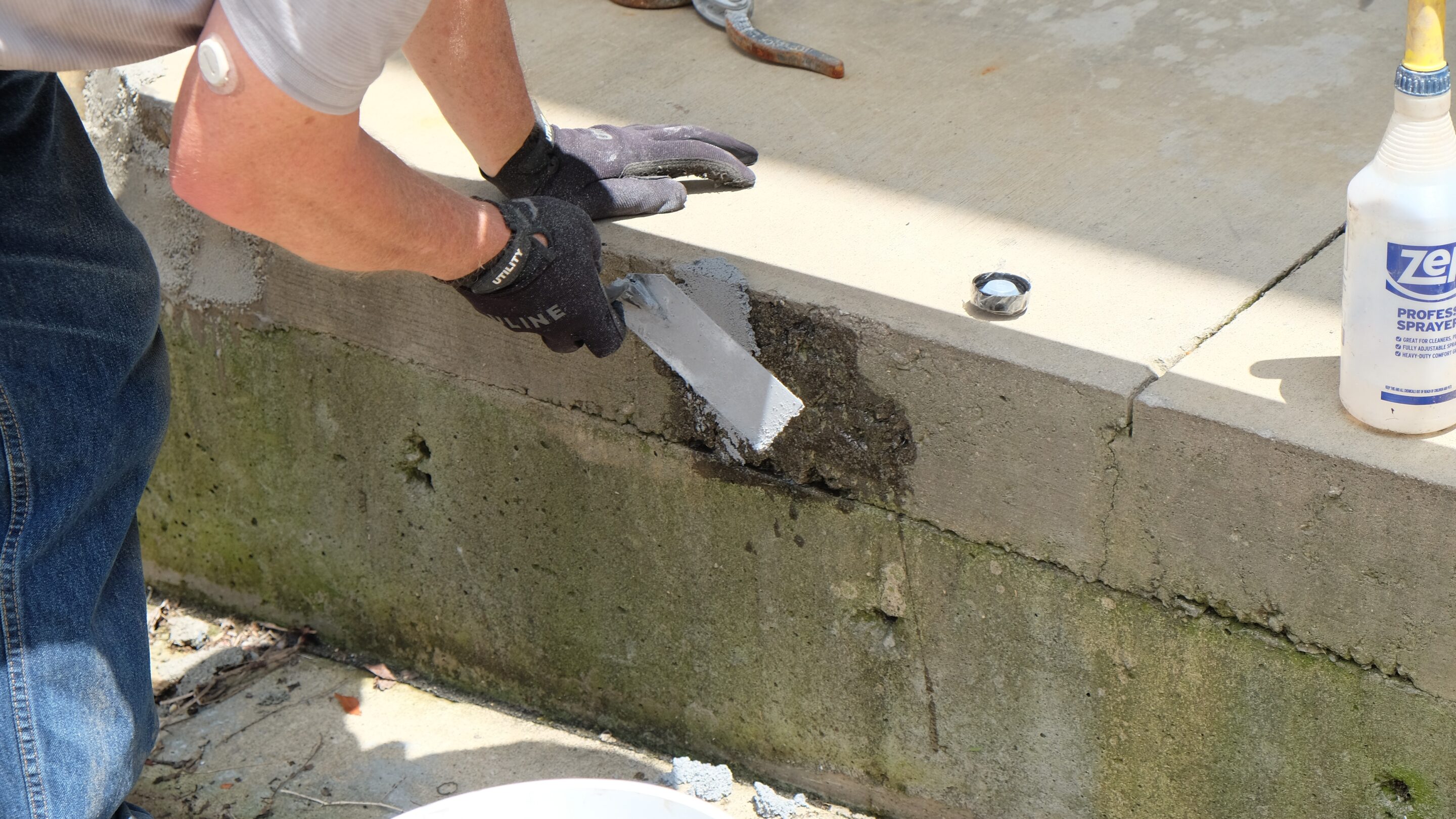
Hand-applied concrete repair is exactly what it sounds like — applying concrete repair mortar by hand or trowel. In certain situations, such as working behind exposed rebar or in tight, hard-to-reach areas, direct hand application is the most practical option.
The versatility of trowel-grade concrete patching is a major advantage. Repairs can be prepped and completed in a single day, work progresses at a controlled pace, and a large crew isn’t required. Two or three workers can efficiently handle multiple small concrete repairs in one shift. The technique is also relatively straightforward to learn — with proper guidance from an experienced applicator and supervised practice, most workers develop proficiency quickly. For accessible repair areas, minimal equipment is needed beyond standard tools like trowels and a concrete mixer.
Hand troweling does have limitations, however. Large-scale structural concrete restoration becomes labor-intensive and difficult to manage with a small team — multiple skilled workers are needed to keep pace with more extensive repairs. Limited site access can also make hand application impractical, as scaffolding introduces added cost and potential trade conflicts. Perhaps most significantly, trowel-grade application is slow, making it a poor fit for time-sensitive concrete repair projects.
Form and Pour Concrete Repair
Form and pour concrete repair involves constructing formwork around the repair zone and using a flowable concrete repair material that can be poured or pumped into place.
This method is particularly effective when rebar is fully exposed. Flowable repair mortars easily penetrate every void within the form — including hard-to-reach spaces behind rebar that would be difficult to address with hand application. The actual placement process is accessible for most workers, as pouring or pumping flowable repair material doesn’t require highly specialized skills. The main requirement is planning for access via a pour hole or pump port.
The challenge with form and pour concrete repair lies in the formwork itself. A skilled carpenter is needed to construct forms that are fully sealed, capable of holding fluid material, and shaped to conform to irregular concrete surfaces. Without that expertise on your crew, this structural repair method becomes significantly less viable.
Low-Pressure Spray Application
Low-pressure spray concrete repair uses a pump combined with air pressure to spray repair mortar onto the surface. The material isn’t fully liquid, but it’s workable enough to bond without slumping or sliding — making it especially well-suited for overhead concrete repair and vertical surface restoration.
Speed is the primary advantage of spray-applied concrete repair. A single nozzleman can apply considerable material per hour without any formwork. The mortar is sprayed directly onto the prepared surface, then struck off and finished. Support crew members — handling prep and mixing — don’t require specialized skills beyond their standard concrete repair knowledge.
The tradeoff is equipment and operator expertise. Low-pressure spray requires a pump capable of handling thick, heavy repair mortar, plus an air compressor. This represents a meaningful capital investment. More critically, a skilled nozzleman is essential. Navigating around rebar, maintaining consistent application depth, and operating at the proper pace are all non-negotiable for a successful spray-applied concrete repair.
Five Key Considerations for Choosing Your Concrete Repair Method
1. Size and Complexity of the Concrete Repair
Some concrete repair projects are small and uncomplicated. Others involve obstructions — conduit runs, piping on slab undersides, or equipment mounted to vertical surfaces — that create significant access challenges.
Trowel-grade hand application is best suited for low-complexity, small-scale concrete patches with easy access. Form and pour handles larger structural concrete repairs well, though achieving the correct finished elevation with formwork can become problematic for oversized areas. Low-pressure spray offers the greatest versatility across concrete restoration scopes — from clusters of small, accessible patches to large repairs on irregular surfaces where forming would be difficult or impractical.
2. Evaluate Your Available Labor
Before committing to any concrete repair method, take an honest inventory of your crew’s capabilities and experience.
Trowel-grade repair has a lower skill threshold, but still requires someone experienced in hand-applying repair mortar with precision and patience. Form and pour concrete repair requires a skilled carpenter for formwork construction, while the remaining crew handles mixing and pouring — making it a strong option when carpentry experience is available on larger projects. Low-pressure spray demands the highest level of applicator expertise. A qualified nozzleman is critical, particularly when the concrete repair area contains numerous embedments or physical restrictions.
3. Equipment Required for the Job
Matching your equipment inventory to your chosen concrete repair method is essential for staying on schedule and on budget.
Trowel-grade application requires minimal equipment — a trowel, a concrete mixer, and you’re ready to work. Form and pour concrete repair is similarly light on equipment needs: basic carpentry tools, a mixer, and optionally a portable pump for larger pours. Low-pressure spray concrete repair is the most equipment-intensive of the three, requiring a specialized pump designed for thick repair mortars and an air compressor to power the spray system — a notable investment for any project.
4. Time and Schedule Expectations
Project timelines and trade coordination are important variables when selecting the right concrete repair method.
Trowel-grade concrete patching has a minimal site footprint and can be performed alongside other trades with easy schedule adjustments — simply add workers to increase output. Form and pour repair requires substantial upfront prep time for formwork construction, though the pour itself moves quickly once forms are in place. Keep in mind that rebar treatments or primers applied before forming have a limited working window — delays can compromise the repair. Low-pressure spray concrete repair is the fastest application method once mobilized, but spray bounce-back and airborne material can interfere with surrounding trades, requiring careful schedule coordination.
5. Overall Cost and Risk of Cost Overruns
Budget risk varies considerably across concrete repair methods, and understanding that exposure is critical before committing to an approach.
Trowel-grade hand application carries low setup costs, which naturally minimizes the risk of significant budget overruns. Form and pour repair involves greater upfront investment in formwork, increasing financial exposure — if forms fail or require rework, additional carpentry costs accumulate rapidly. Low-pressure spray carries the highest financial risk of the three concrete repair methods. Renting or purchasing a pump without a trained, experienced nozzleman can result in repair failures, forcing the work to be redone entirely — a costly outcome on any structural restoration project.
Choosing the Right Vertical and Overhead Concrete Repair Method
There is no universal “best” method for vertical and overhead concrete repair. The right concrete repair technique depends on the specific conditions of your project — the size and complexity of the structural repair, your crew’s skill set, available equipment, schedule requirements, and overall budget. Whether you’re restoring parking garage ceilings, bridge components, or commercial building facades, carefully weighing these five factors against the strengths and limitations of each repair method will position your project for success from the start.
For help selecting the right repair mortar or application method for your next vertical or overhead concrete restoration project, consider consulting with a concrete repair specialist or material supplier who can assess your specific conditions and recommend the most durable, long-lasting solution.
Need Help With Your Concrete Repair Job?
We’re here to answer all of your questions about concrete repair, product compatibility, and application techniques. Get expert guidance for your specific project needs.
Professional Grade Products
Quality Customer Service
Technical Support