About Sika Greenstreak Base Seal PVC Waterstop
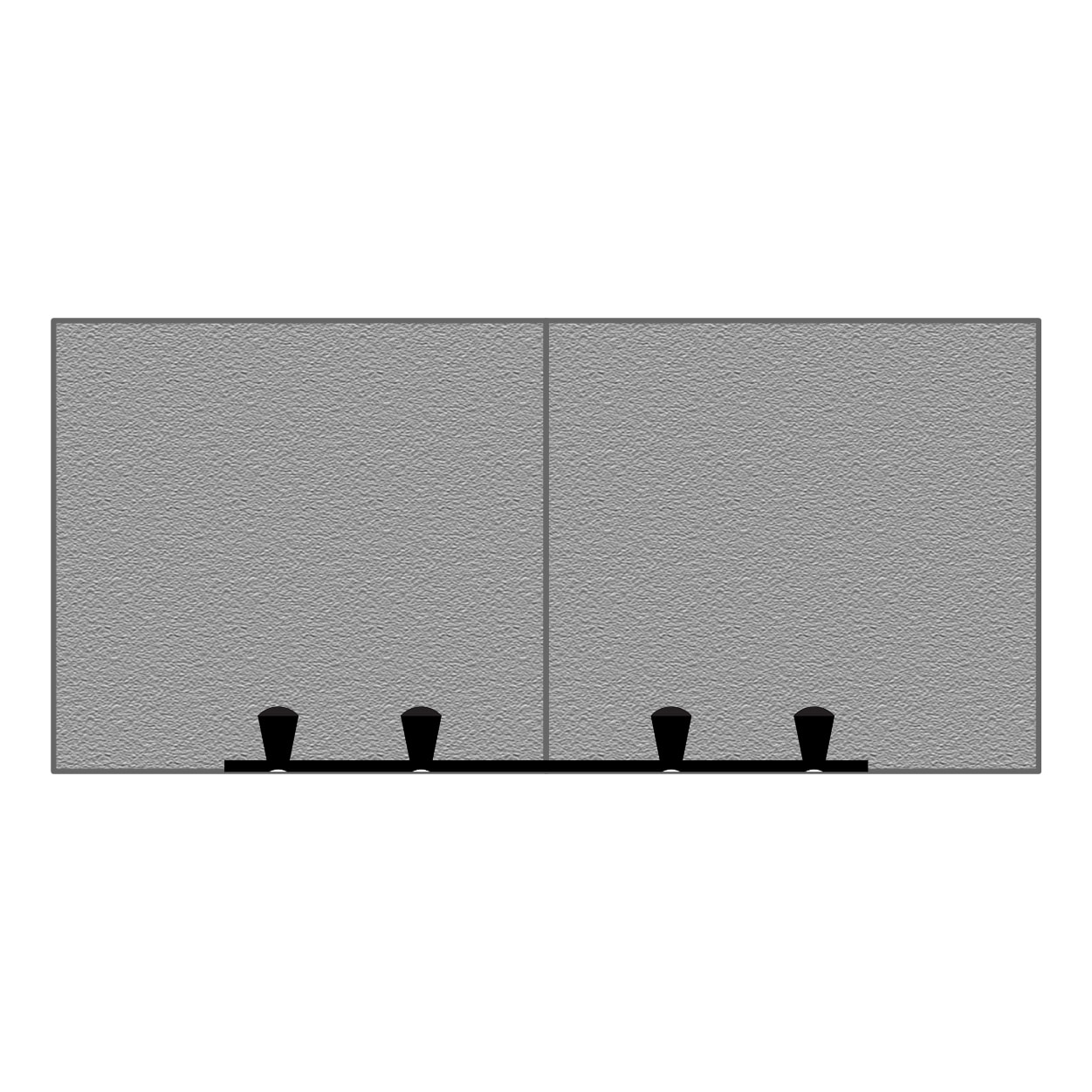
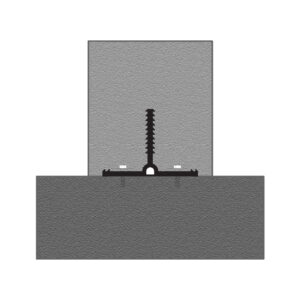
Sika Greenstreak base seal PVC waterstop is specified for joints where the waterstop is installed along the exterior face of the concrete rather than embedded across the joint. The flat base sits against the form or substrate on the water side of the structure and is encapsulated as the concrete is placed. This positioning makes base seal profiles particularly well suited to slab-on-grade joints and backfilled walls, where single-sided formwork or earth-side waterproofing is the natural construction sequence. The result is a continuous diaphragm intended to prevent the passage of liquid through the joint, installed without the split formwork required for embedded profiles.
Standard base seal profiles (without a tear web) are typically used in non-moving or limited-movement joints. They are easy to form and position, though they do have some limitations with transitions and intersections compared to symmetrical embedded profiles. Base seal waterstops are produced in widths from 6 inches up to 9 inches across a range of weights and head pressure ratings, with several profiles tied to specific engineering and government standards such as Corps of Engineers and New York D specifications. See the sizing reference below or reach out for help selecting a profile for your specification.
Typical Applications
✓Commonly Specified For
- Slab-on-grade joints
- Backfilled wall joints with exterior-side waterproofing
- Non-moving and limited-movement construction joints
- Applications where split formwork is impractical
- Water and wastewater treatment plants
- Reservoirs, tunnels, and containment structures
- Potable water contact applications
- Corps of Engineers and New York D specifications
→Other Profiles May Be Considered When
- The joint will experience significant movement — see Base Seal with Tear Web
- The waterstop will be embedded across the joint — see Ribbed Centerbulb or Flat Ribbed
- Complex transitions and intersections are required throughout the project
- The joint is at an existing concrete face — see Retrofit profiles
- A keyed vertical joint is preferred — see Labyrinth
Profile selection should always be verified against project specifications and engineering requirements. Contact us if you’d like assistance reviewing options for your application.
Available Sizes: Profiles 771, 772, 775, and 776s
Sika Greenstreak produces base seal waterstop in a range of profile sizes to suit different joint widths, project specifications, and head pressure ratings.
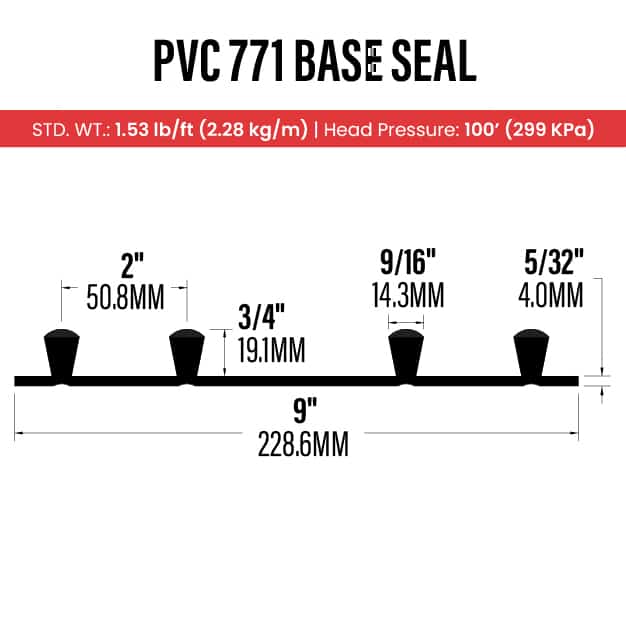
Profile 771
Width: 9″
Weight: 1.53 lb/ft
Head Pressure: 100 ft (299 kPa)
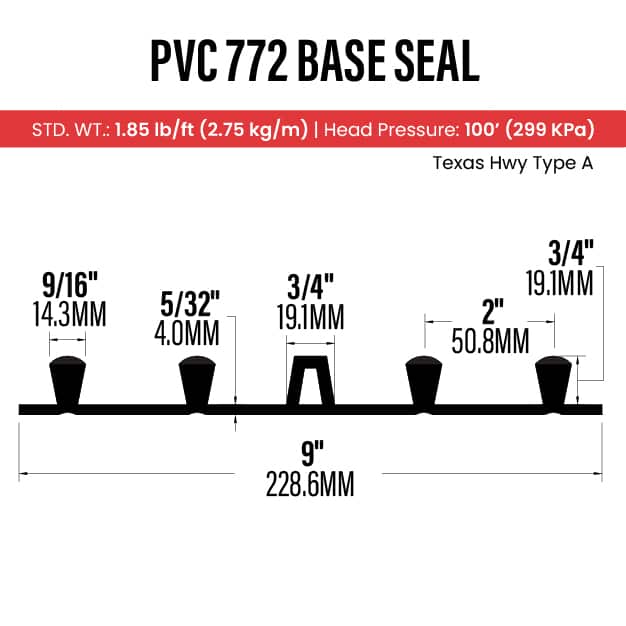
Profile 772
Width: 9″
Weight: 1.85 lb/ft
Head Pressure: 100 ft (299 kPa)
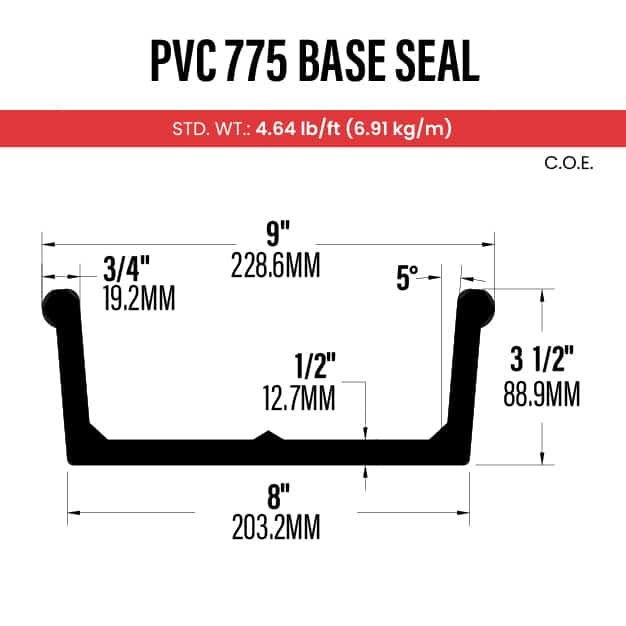
Profile 775
Width: 9″ (8″ base)
Weight: 4.64 lb/ft
Head Pressure: 100 ft (299 kPa)
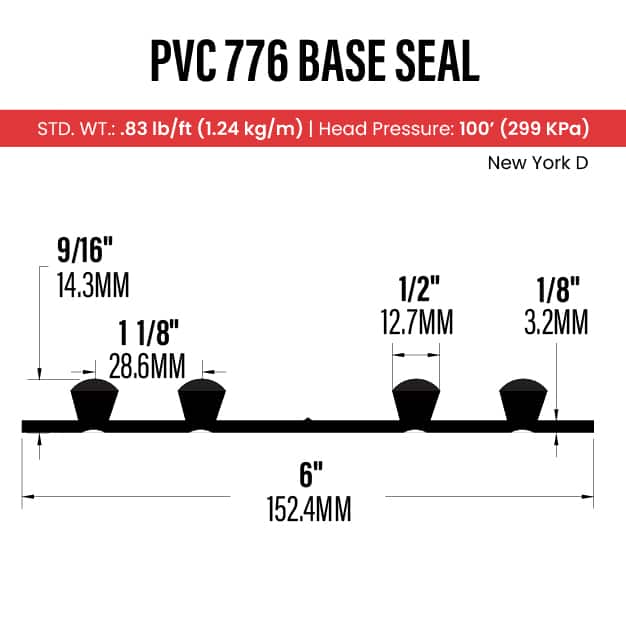
Profile 776
Width: 6″
Weight: 0.83 lb/ft
Head Pressure: 100 ft (299 kPa)
Sizing considerations generally include hydrostatic head, concrete cover, and any project-specific or DOT specifications. Contact us if you’d like help cross-referencing a profile against your spec.
Base Seal Waterstop Installation Overview
Base seal waterstops are installed along the exterior (water-side) face of the concrete rather than embedded across the joint. The flat base is positioned against the formwork or substrate, centered over the joint location, and concrete is placed to encapsulate the base. Heat welding is generally the recognized method for splicing PVC waterstop, and factory-fabricated transitions are particularly important for base seal profiles given their limitations at intersections. Always refer to the manufacturer’s installation guide and project specifications for complete instructions.
Lay the flat base against the formwork or substrate, centered over the eventual joint location.
Anchor the base to the form or substrate to prevent shifting during concrete placement.
Heat-weld butt splices in the field. Factory fabrications are strongly recommended for changes of direction.
Place and consolidate concrete to fully encapsulate the base and form a continuous diaphragm.
Frequently Asked Questions
+What’s the difference between a base seal and an embedded waterstop?
A traditional embedded waterstop is installed across the joint with roughly half the profile in each pour, forming a diaphragm through the thickness of the concrete. A base seal waterstop is installed along the exterior face of the concrete on the water side, with the flat base anchored against the form or substrate. Base seal profiles are easier to position with single-sided formwork and are commonly used in slab-on-grade and backfilled wall applications. They do have some limitations with transitions and intersections compared to embedded profiles.
+What’s the difference between base seal and base seal with tear web?
Both are installed against the exterior face of the concrete using the same base seal approach. The difference is movement capacity. Standard base seal profiles (771, 775, 776) don’t have a tear web, so they’re intended for non-moving or limited-movement joints. Base seal with tear web (profile 772) adds an engineered tear web and U-bulb that rupture as the joint opens, allowing it to accommodate significant lateral, transverse, and shear movement.
+Which Sika Greenstreak base seal profile should I specify?
Selection typically comes down to project specifications, hydrostatic head, and width requirements. The 776 (6″) is the lightest profile and is tied to the New York D standard. The 771 (9″) is a mid-weight 9″ profile rated for 100 ft of head pressure. The 775 is a heavy-duty 9″ profile (4.64 lb/ft) tied to the Corps of Engineers specification. If your specification calls out a profile by number or references a specific engineering standard, that’s the deciding factor — otherwise, project-specific requirements should drive the final selection.
+Can base seal profiles be installed on vertical walls?
Yes, base seal profiles can be installed on vertical wall surfaces as well as horizontal slabs. The base is anchored against the formwork or substrate on the water-side face of the wall, centered over the joint. This makes them a common choice for backfilled walls where waterproofing is needed on the exterior face and split formwork would be difficult to set.
+Why are factory fabrications especially important for base seal profiles?
Base seal waterstops have some inherent limitations with transitions and intersections because the asymmetrical geometry doesn’t lend itself as cleanly to L’s, T’s, and crosses as a symmetrical embedded profile does. Field-fabricated intersections are widely cited as a leading cause of waterstop performance issues across all profile types, but the limitation is more pronounced with base seal shapes. Sika strongly recommends factory-made fabrications for any change of direction.
+Are base seal profiles suitable for potable water structures?
All Sika Greenstreak PVC waterstop profiles, including each base seal size, are NSF/ANSI 61 certified for potable water contact. This makes them appropriate for many applications such as finished water reservoirs and treatment plant clearwells, subject to project-specific requirements.
+How do you heat-weld base seal PVC waterstop in the field?
PVC waterstop is typically heat-welded using a thermostatically controlled splicing iron. The two ends are squared, butted against the heated blade until the PVC begins to melt, then pressed together and held until cool. Sika offers a Waterstop Welding Certification Program for contractors seeking formal training, as weld quality has a significant impact on long-term performance.
+Which base seal profile meets Corps of Engineers specification CRD-C 572-74?
All Sika Greenstreak PVC waterstop profiles meet the general material requirements of Corps of Engineers Specification CRD-C 572-74. For base seal specifically, Profile 775 is the heavy-duty 9″ option (4.64 lb/ft) most commonly specified for Corps of Engineers projects. Profile 776 (6″) is tied to the New York D standard. If your project specification calls out a profile by number or references a specific engineering standard, that should drive the final selection — contact us if you’d like help cross-referencing your spec against the available profiles.