
Everything engineers, specifiers, and contractors need to know about flexible PVC waterstops — from joint type selection and profile geometry to head pressure ratings, installation requirements, and the complete Sika Greenstreak product lineup.
What is a PVC waterstop?
A PVC waterstop is a length of extruded polyvinyl chloride profile installed inside a concrete joint to block water from migrating through that joint after the structure is in service. Waterstops are used everywhere two concrete pours meet — construction joints, expansion joints, contraction joints, and isolation joints — and they are the difference between a watertight structure and one that develops leaks at every seam.
Flexible PVC has become the default material for embedded waterstops because no other product offers the same combination of long-term elasticity, broad profile selection, and chemical resistance at a comparable cost. Polyvinyl chloride waterstop is recognized under ACI 350 for environmental engineering concrete structures, holds up against most waterborne chemicals encountered in municipal and industrial applications, and can be heat welded on site or fabricated at the factory into custom corners, tees, intersections, and transitions for fully continuous joint coverage. PVC will not stain concrete and does not produce electrolytic action against embedded reinforcing steel.
Cast directly into both sides of a concrete joint during original construction. The standard installation method for new construction and the most common use of PVC waterstop overall.
Mechanically anchored to the face of an existing concrete structure before a new pour. Used when one side of the joint is already hardened concrete and embedding isn’t possible.
Every Sika Greenstreak PVC waterstop profile is extruded from a self-compounded, prime virgin PVC formulation — no regrind, no recycled content — and tested to meet or exceed U.S. Army Corps of Engineers Specification CRD-C 572-74. The entire line is NSF/ANSI 61 certified for direct contact with potable drinking water.
How PVC waterstops work
PVC waterstop is installed in the joint before the first concrete pour, with roughly half of the profile cast into the first concrete element and the remaining half extending into the volume that will be filled by the adjacent pour. Split formwork or specialized waterstop chairs hold the profile centered on the joint line and keep it from shifting as concrete is placed and consolidated around it.
Embedment: Half of the waterstop profile is cast into each side of the joint, with the centerline of the waterstop aligned to the centerline of the joint. The ribs, dumbbell bulbs, or centerbulb sit fully encapsulated in concrete once both pours cure.
Mechanical interlock: The profile geometry forces any water reaching the joint to travel a long, indirect path through dense concrete and tightly bonded PVC before it can cross to the other side. That path is effectively sealed against hydrostatic pressure for the service life of the structure.
Movement accommodation: Where the joint moves, a centerbulb or tear web positioned along the joint line gives the PVC room to stretch, compress, or shear as the joint opens and closes, without putting the material into tensile failure.
Why flexible PVC? Polyvinyl chloride combines long-term elasticity, broad chemical resistance, and the ability to be heat welded into continuous transitions and intersections. It will not discolor concrete, produce electrolytic action against rebar, or degrade under sustained water contact.
Moving vs. non-moving joints
The first decision in any PVC waterstop specification is whether the joint is expected to move during the structure’s service life. Joint movement — or the absence of it — determines which profile geometry will perform, and getting this wrong is the single most common cause of waterstop failure.
Engineered to absorb dimensional change from concrete shrinkage, thermal cycling, structural settlement, long-term creep, and live-load deflection. Includes expansion joints, contraction joints, and isolation joints.
Requires: a centerbulb, tear web, or similar deformable element along the joint line that absorbs lateral, transverse, and shear movement.
Typically construction joints between sequential concrete pours where continuous bonded reinforcement crosses the joint and essentially no movement occurs after curing. Most cold joints in walls, slabs, and foundations.
Requires: a flat ribbed or dumbbell profile without a centerbulb — geometry focused entirely on sealing rather than movement.
PVC waterstop profile types
PVC waterstops are extruded in nine distinct profile families, each one developed for a specific joint condition. Understanding what each profile does — and where it doesn’t belong — is the foundation of any well-specified waterstop system.
The most commonly specified flexible waterstop in the industry. A hollow centerbulb deforms freely under joint movement while ribs on each flange anchor the waterstop into the surrounding concrete.
A movement-absorbing centerbulb paired with bulb-shaped flange ends. The dumbbells lock into each concrete pour while the centerbulb handles lateral, transverse, and shear joint movement.
Built for joints with large dimensional change. A sacrificial tear web breaks by design when the joint opens, releasing the U-bulb to deform without ever putting the PVC into tensile stress.
The go-to profile for non-moving construction joints. A continuous series of ribs across the full width maximizes mechanical interlock with the concrete and delivers excellent sealing.
A simpler, more economical alternative for non-moving joints. Bulb-shaped flanges at each edge key tightly into the surrounding concrete to form a watertight seal with less material.
Surface-applied to the back face of the joint instead of embedded inside it. Ideal for slab-on-grade pours and backfilled walls where one side of the joint is inaccessible to split formwork.
Streamlines forming on straight construction joints. The split flange attaches to the bulkhead during the first pour, then closes and gets cast into the second pour. Limited to straight runs only.
A dual-purpose profile that intentionally creates a weak plane to force shrinkage cracks at a chosen location, while simultaneously serving as the waterstop at that planned crack.
The only viable PVC waterstop for joints where new concrete is poured against an existing structure. Mechanically anchored with stainless steel batten bars, anchor bolts, and structural epoxy.
Section 05
Product lineup: Sika Greenstreak PVC waterstops
The Sika Greenstreak line covers every joint condition in modern concrete construction — from 4″ dumbbell profiles for foundation walls to 12″ centerbulb profiles rated for over 200 feet of hydrostatic head. Profiles are grouped below by category.
Ribbed centerbulb profiles
The most heavily specified PVC waterstop category for water-retaining structures with movement joints. Hollow centerbulb absorbs joint flex while ribs grip into both concrete pours.
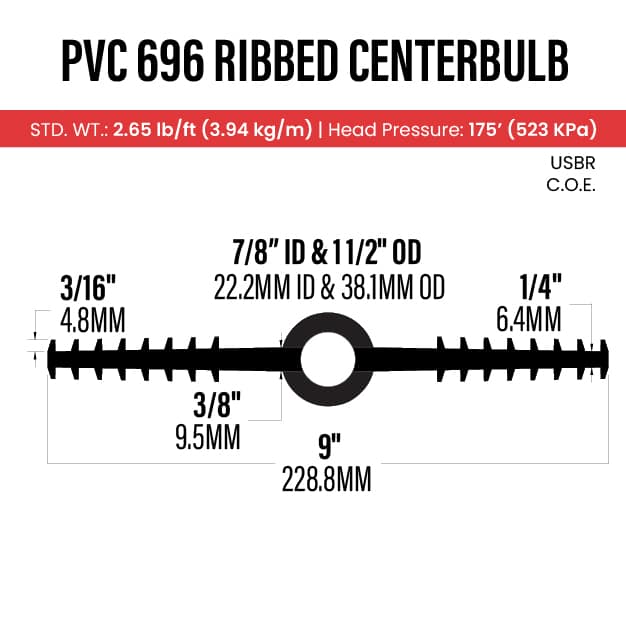
9″ · 3/16″ thick · 2.65 lb/ft · 175 ft head (523 kPa)
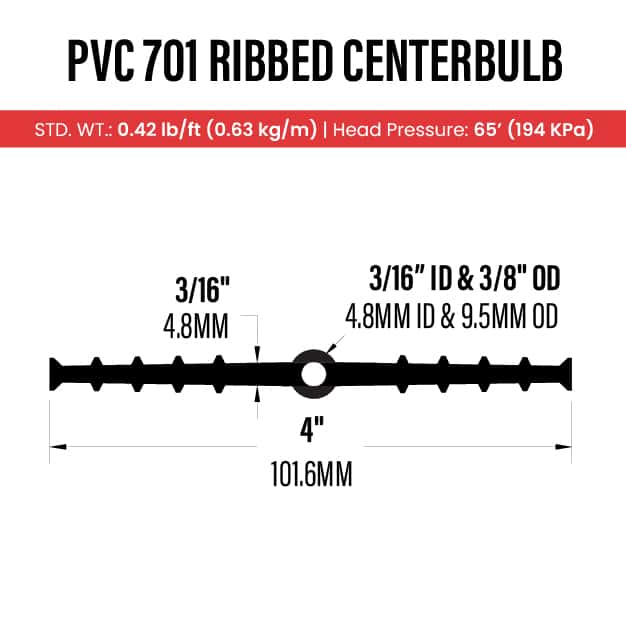
4″ · 3/16″ thick · 0.42 lb/ft · 65 ft head (194 kPa)
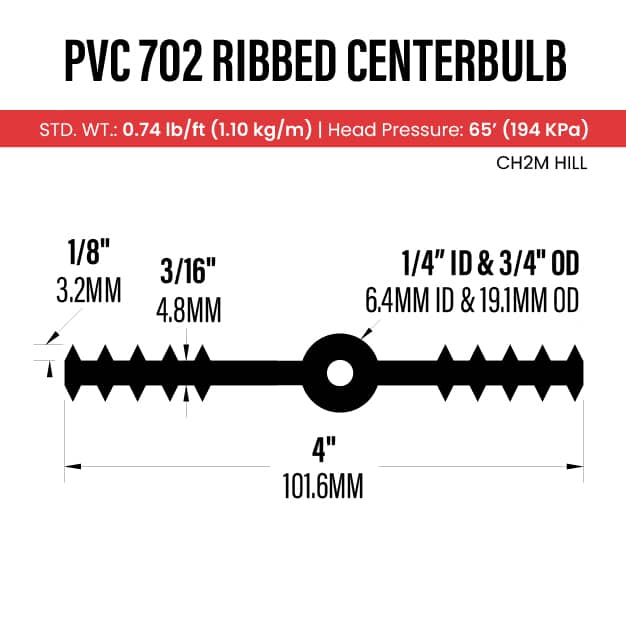
4″ · 3/16″ thick · 0.74 lb/ft · 65 ft head (194 kPa)
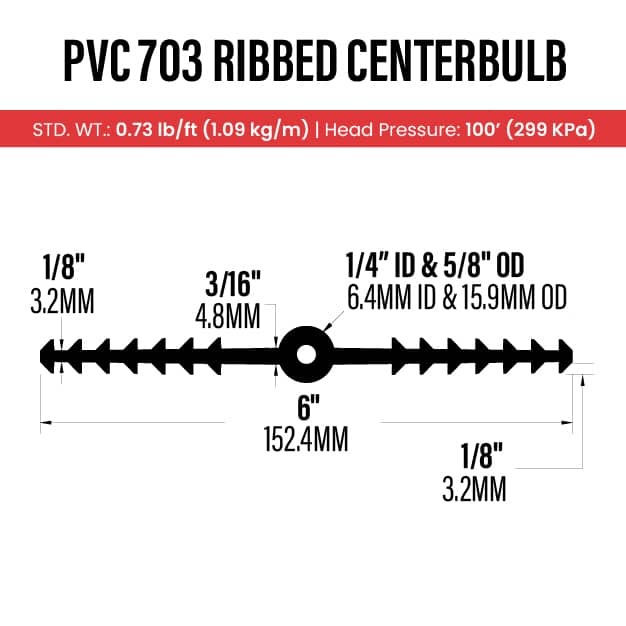
6″ · 3/16″ thick · 0.73 lb/ft · 100 ft head (299 kPa)
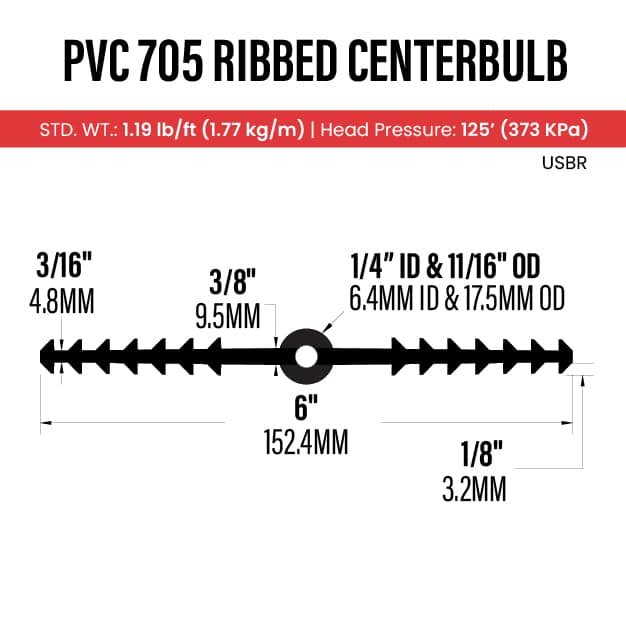
6″ · 3/8″ thick · 1.19 lb/ft · 125 ft head (373 kPa)
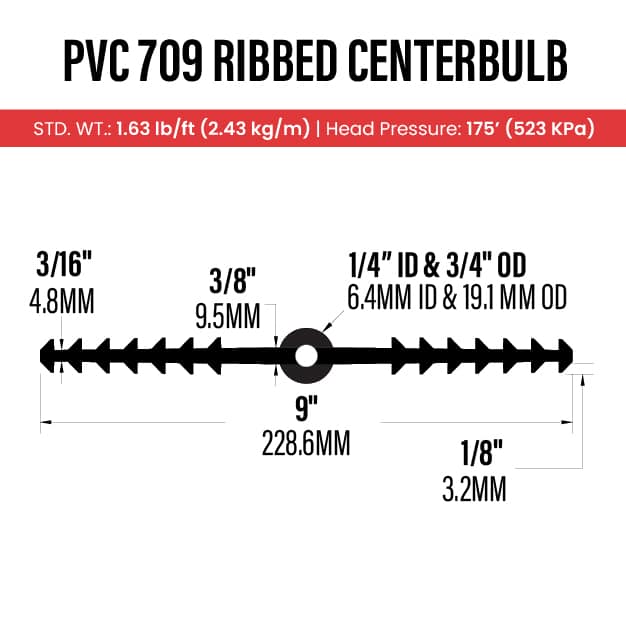
9″ · 3/8″ thick · 1.63 lb/ft · 175 ft head (523 kPa)
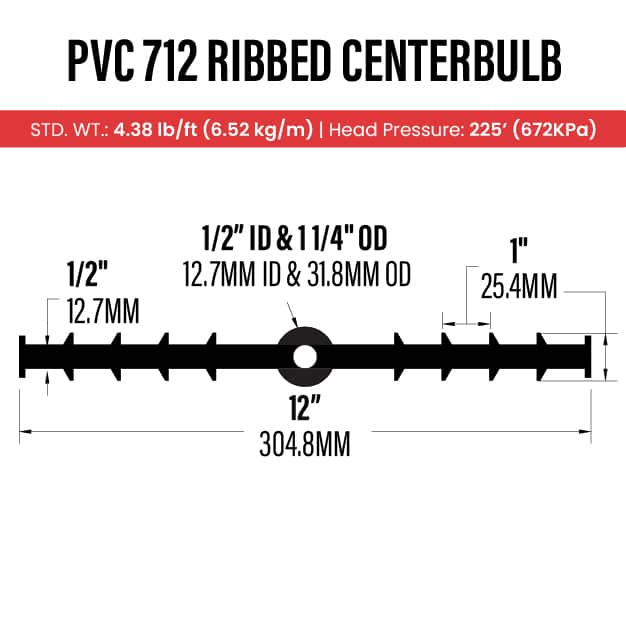
12″ · 1/2″ thick · 4.38 lb/ft · 225 ft head (672 kPa)
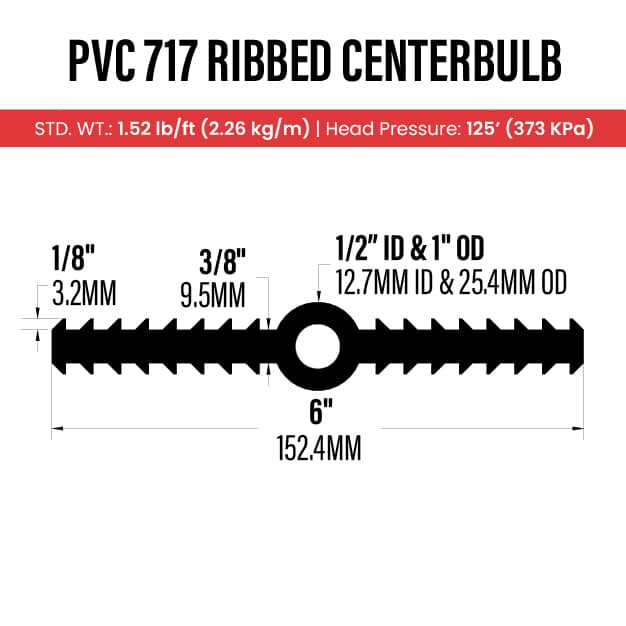
6″ · 3/8″ thick · 1.52 lb/ft · 125 ft head (373 kPa)
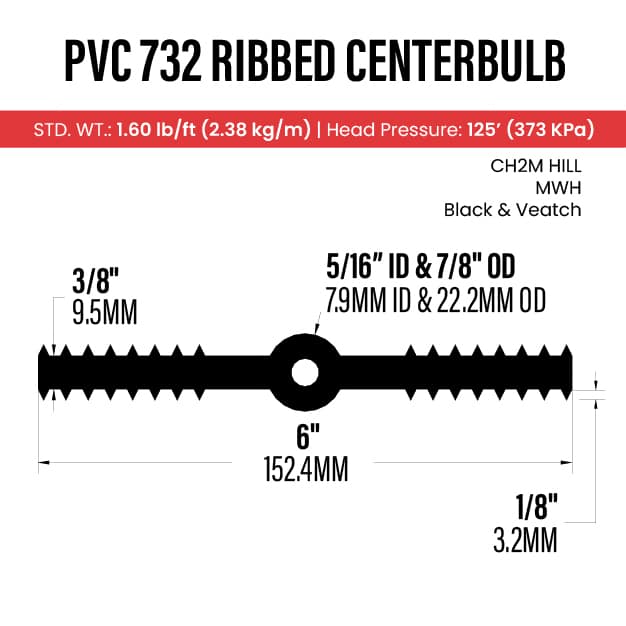
6″ · 3/8″ thick · 1.60 lb/ft · 125 ft head (373 kPa)
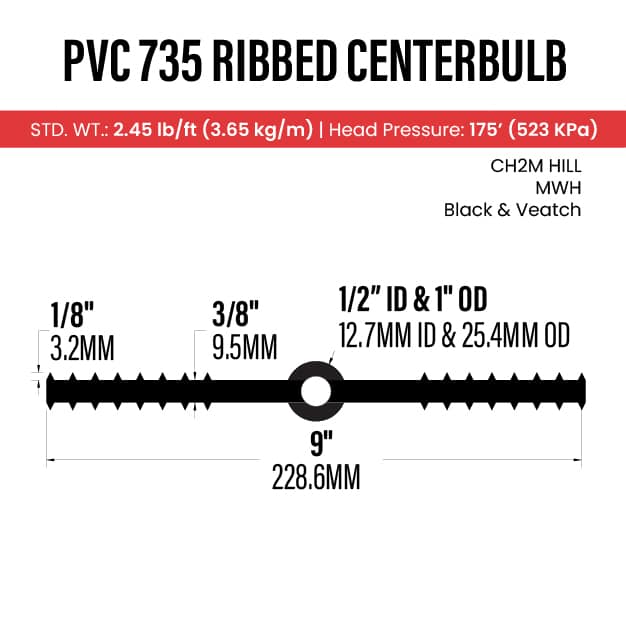
9″ · 3/8″ thick · 2.45 lb/ft · 175 ft head (523 kPa)
Dumbbell centerbulb profiles
The same movement-absorbing centerbulb paired with bulb-shaped flange ends instead of multi-rib flanges. Often chosen where forming details favor smooth flanges.
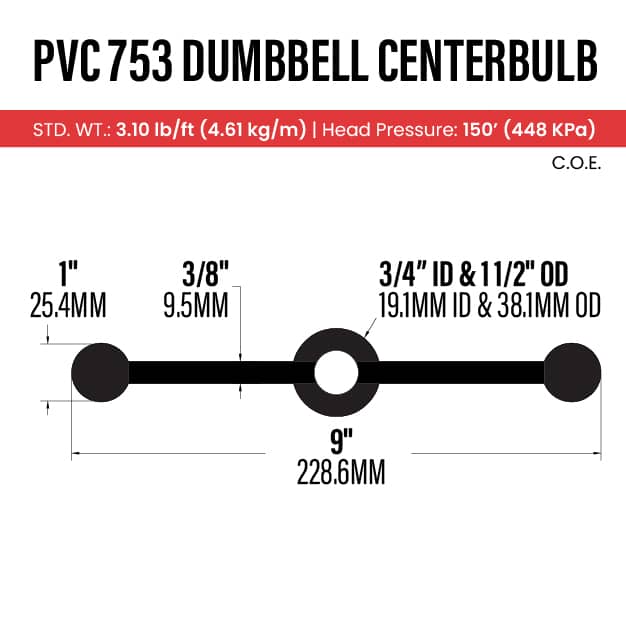
9″ · 3.10 lb/ft · 150 ft head (448 kPa)
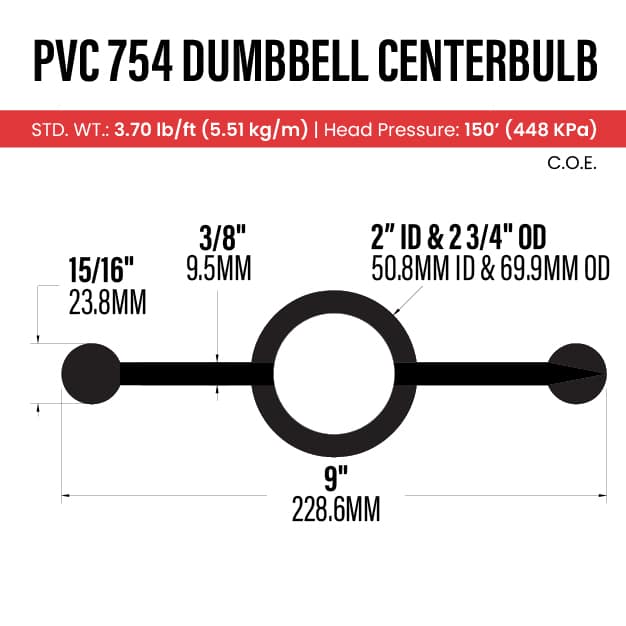
9″ · 3.70 lb/ft · 150 ft head
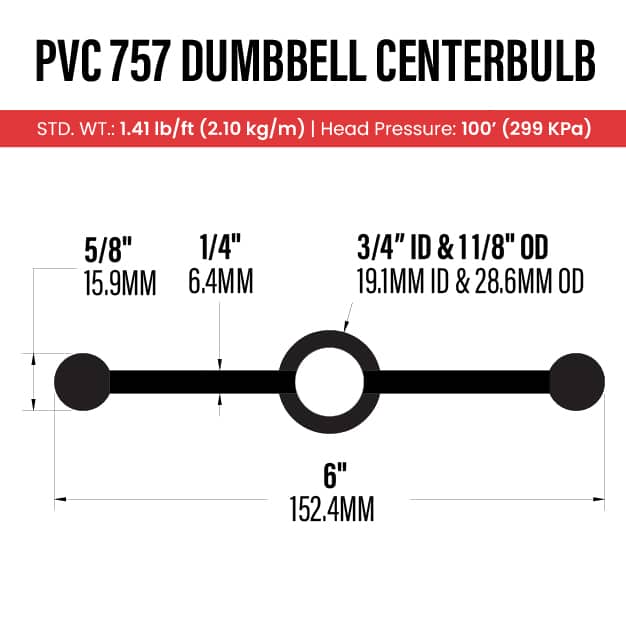
6″ · 1.41 lb/ft · 100 ft head (299 kPa)
Ribbed tear web profiles
For joints with movement too large for a conventional centerbulb. The tear web breaks in tension as the joint opens, freeing the U-bulb to fold and flex.
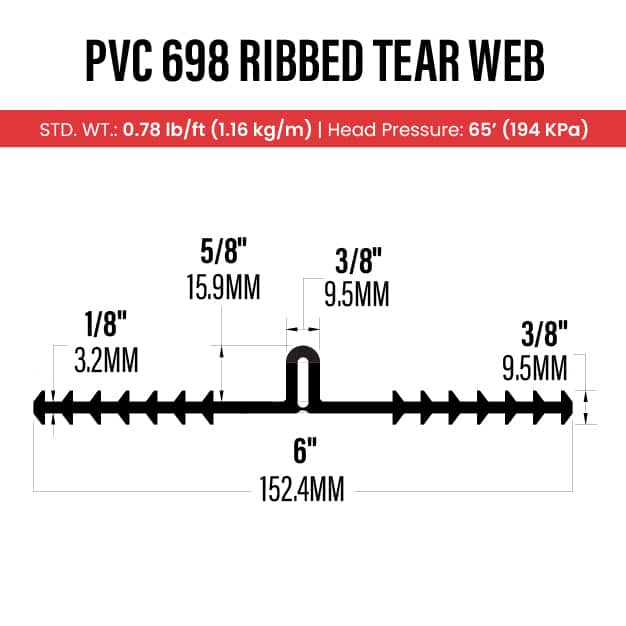
6″ · 0.78 lb/ft · 65 ft head (194 kPa)
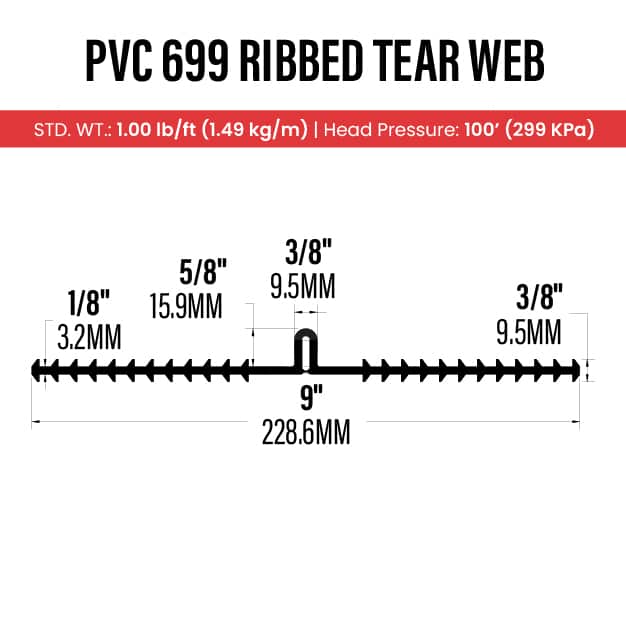
9″ · 1.00 lb/ft · 100 ft head (299 kPa)
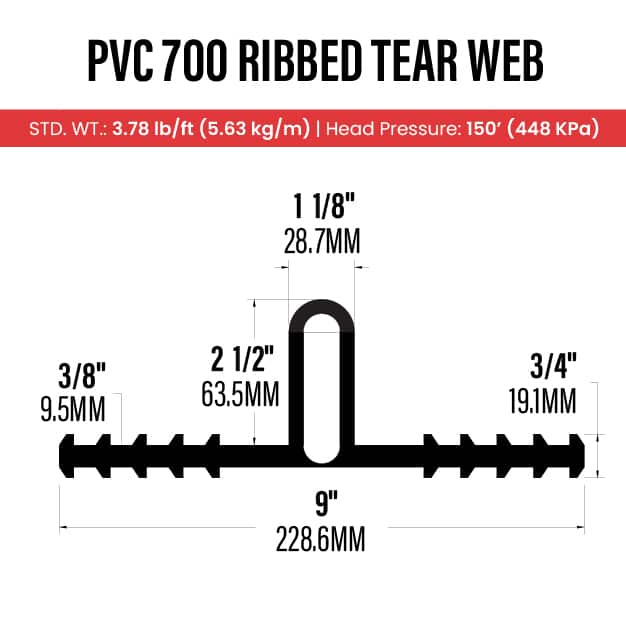
9″ · 3.78 lb/ft · 150 ft head (448 kPa)
Flat ribbed profiles
The workhorse choice for non-moving construction joints. Every square inch is dedicated to sealing — densely packed ribs maximize water path length across the joint.
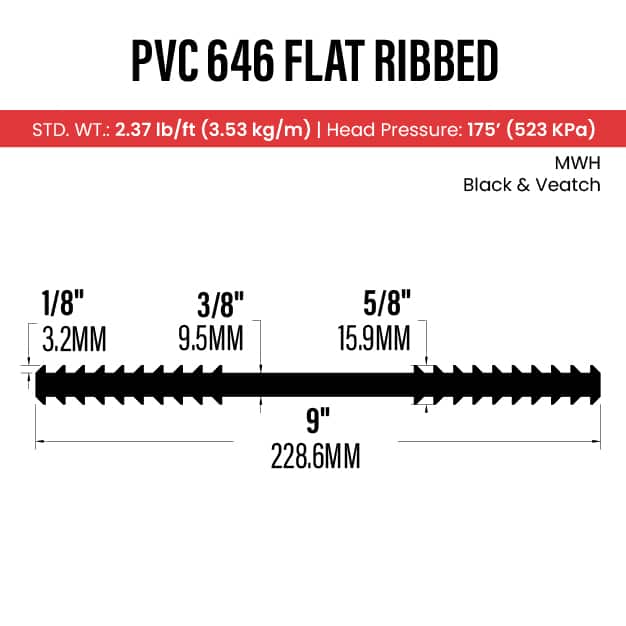
9″ · 3/8″ thick · 2.37 lb/ft · 175 ft head (523 kPa)
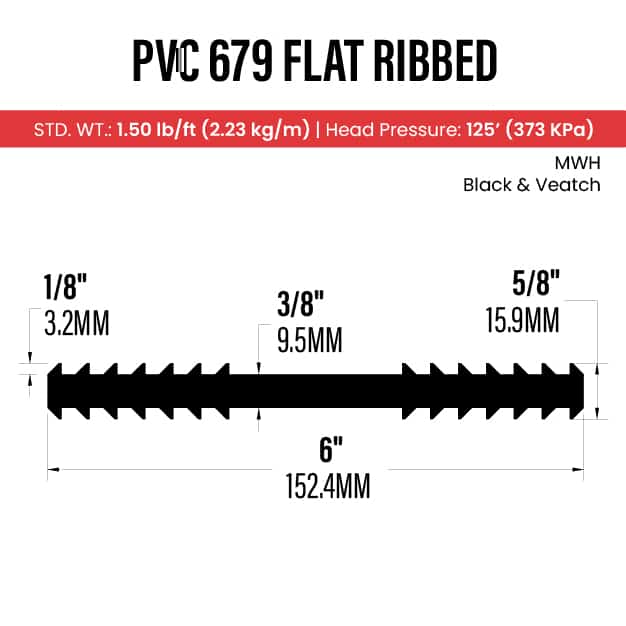
6″ · 3/8″ thick · 1.50 lb/ft · 125 ft head (373 kPa)
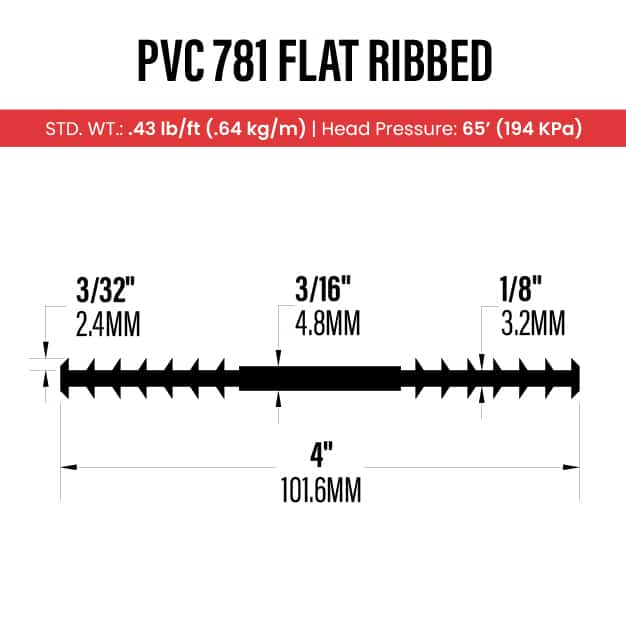
4″ · 3/16″ thick · 0.43 lb/ft · 65 ft head (194 kPa)
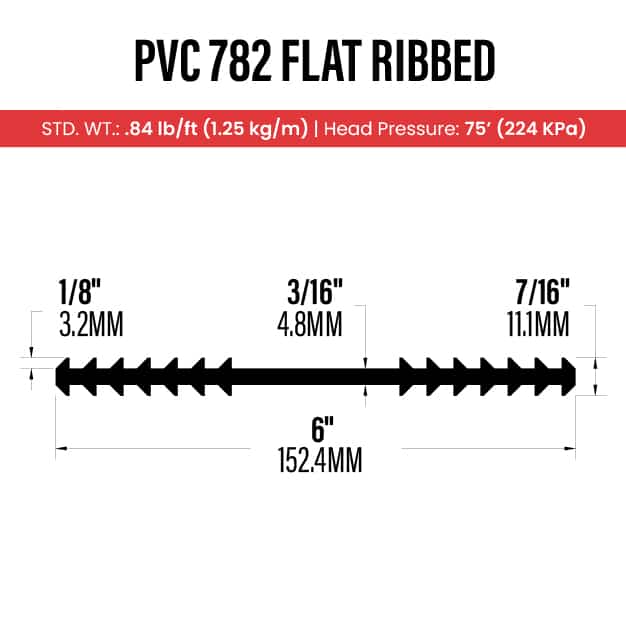
6″ · 3/16″ thick · 0.84 lb/ft · 75 ft head (224 kPa)
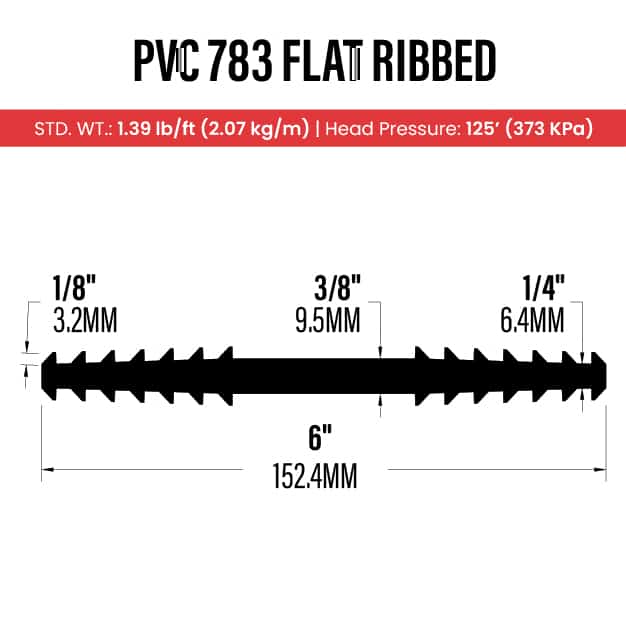
6″ · 3/8″ thick · 1.39 lb/ft · 125 ft head (373 kPa)
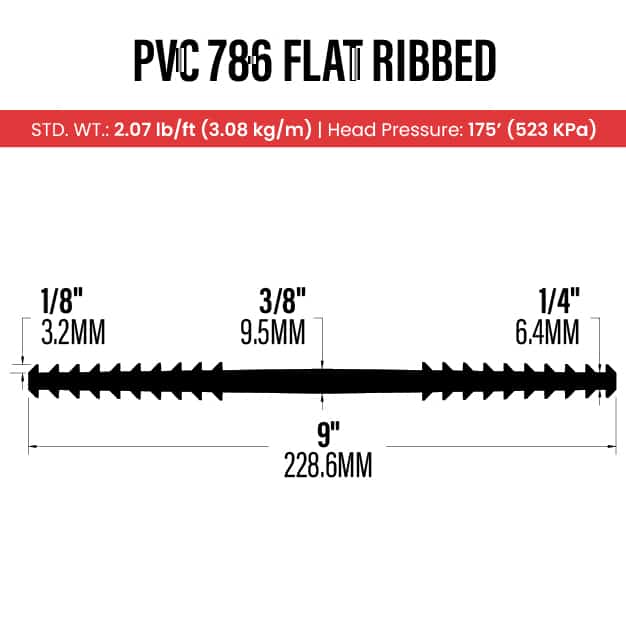
9″ · 3/8″ thick · 2.07 lb/ft · 175 ft head (523 kPa)
Dumbbell profiles
An economical option for non-moving construction joints. Bulb-shaped flanges create solid mechanical interlock with less material than a fully ribbed profile.
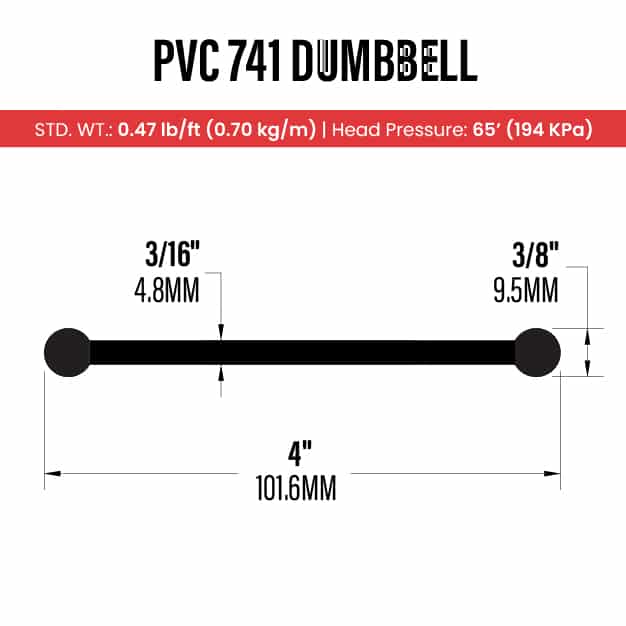
4″ · 3/16″ thick · 0.47 lb/ft · 65 ft head (194 kPa)
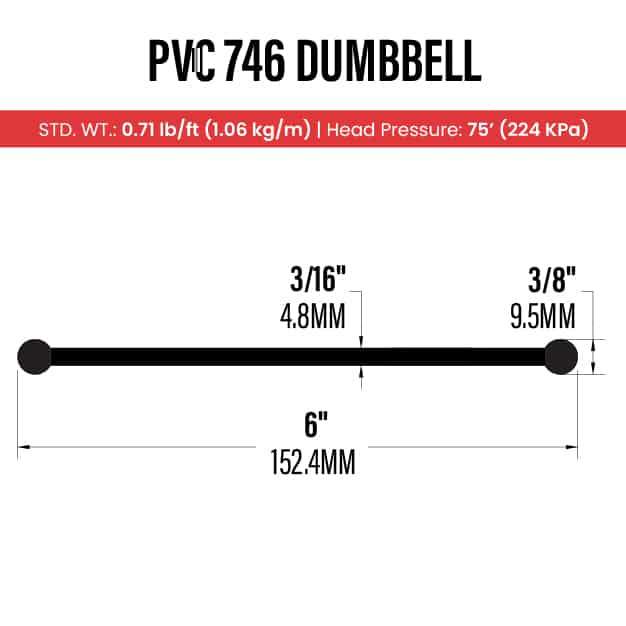
6″ · 3/16″ thick · 0.71 lb/ft · 75 ft head (224 kPa)
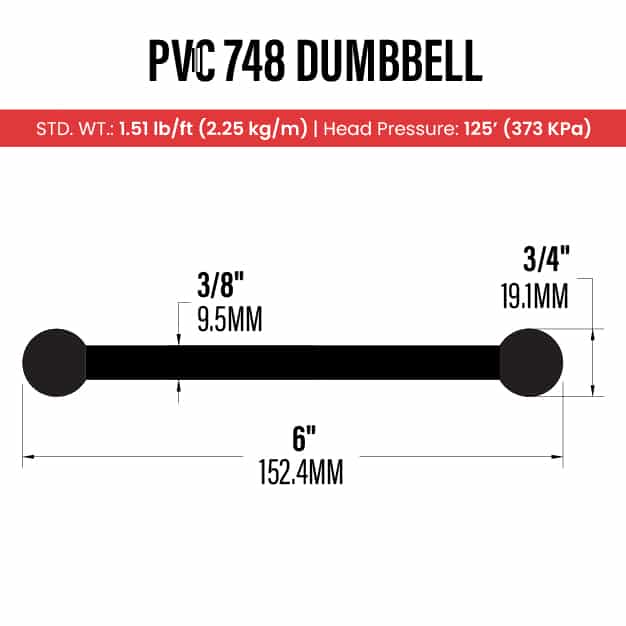
6″ · 3/8″ thick · 1.51 lb/ft · 125 ft head (373 kPa)
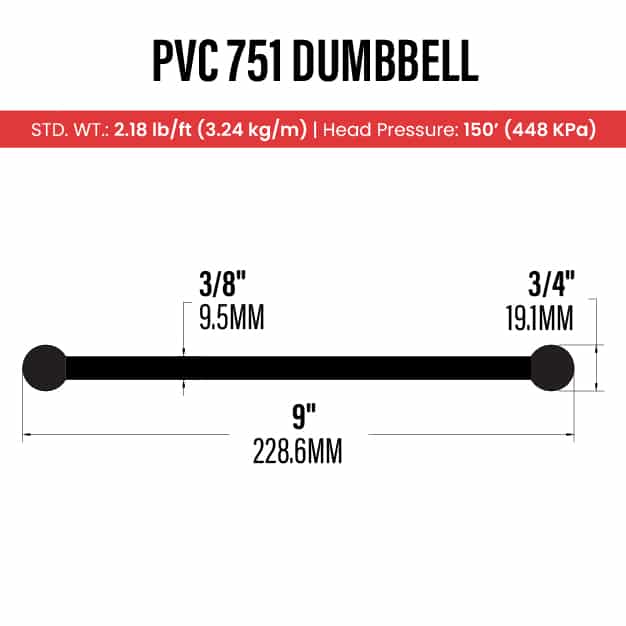
9″ · 3/8″ thick · 2.18 lb/ft · 150 ft head (448 kPa)
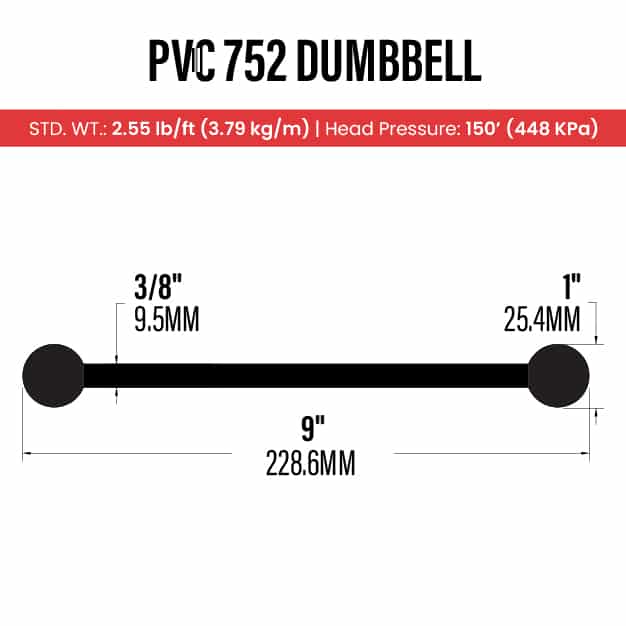
9″ · 3/8″ thick · 2.55 lb/ft · 150 ft head (448 kPa)
Base seal profiles
Surface-applied to the back face of the joint. Invaluable for slab-on-grade pours and backfilled walls where one side is inaccessible to split formwork.
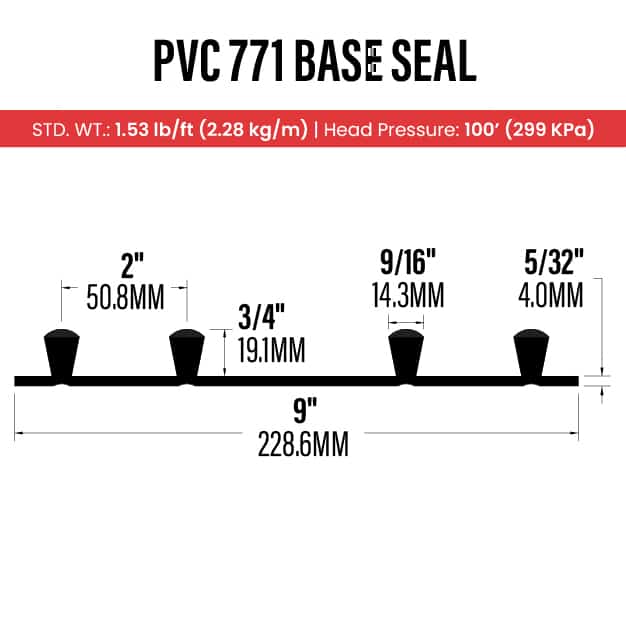
9″ · 1.53 lb/ft · 100 ft head (299 kPa)
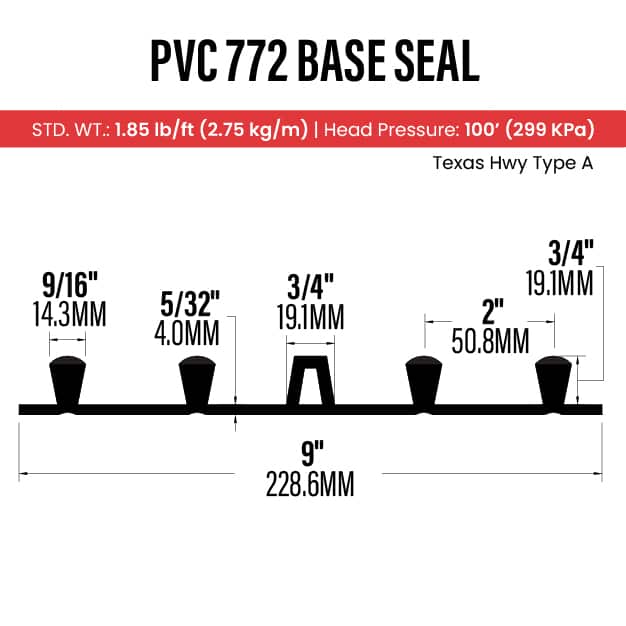
9″ · 1.85 lb/ft · 100 ft head (299 kPa)
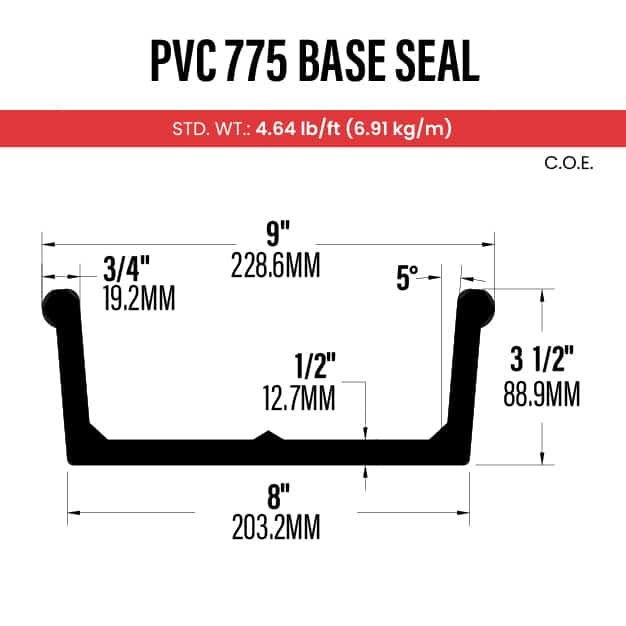
9″ · 4.64 lb/ft · heavy-duty base seal
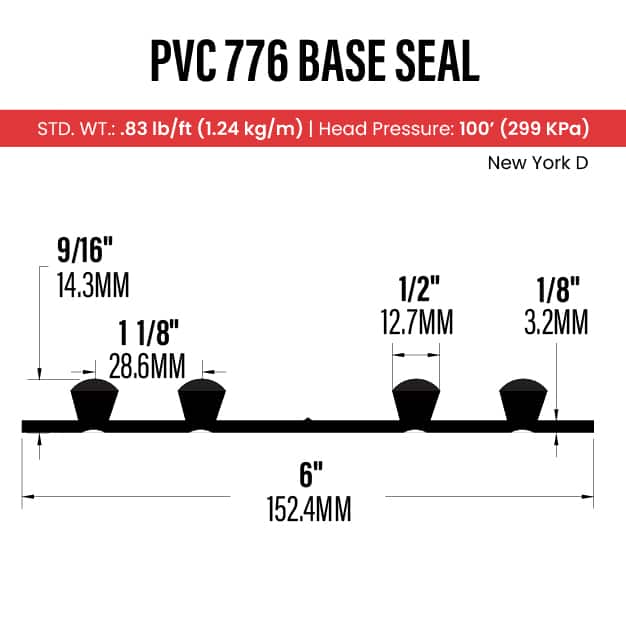
6″ · 0.83 lb/ft · 100 ft head (299 kPa)
Split flange profiles
Designed to make forming easier on straight construction joints. The split flange opens to attach to a bulkhead, then closes for the second pour. Straight runs only.
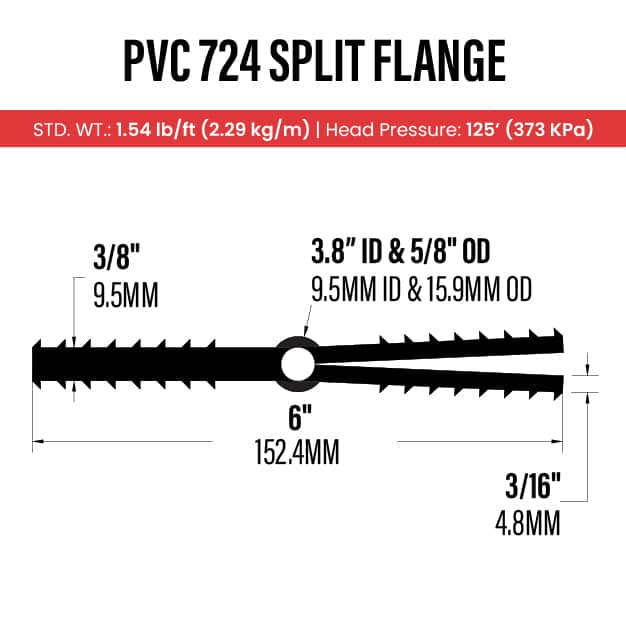
6″ · 3/8″ thick · 1.54 lb/ft · 125 ft head (373 kPa)
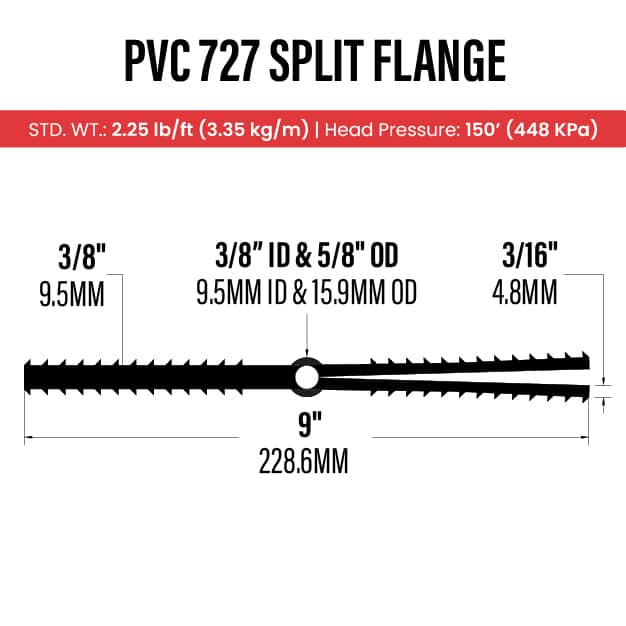
9″ · 3/8″ thick · 2.25 lb/ft · 150 ft head (448 kPa)
Crack inducer profile
A specialty PVC profile that controls where shrinkage cracks form in long slabs or walls, while simultaneously serving as the waterstop at that planned crack location.
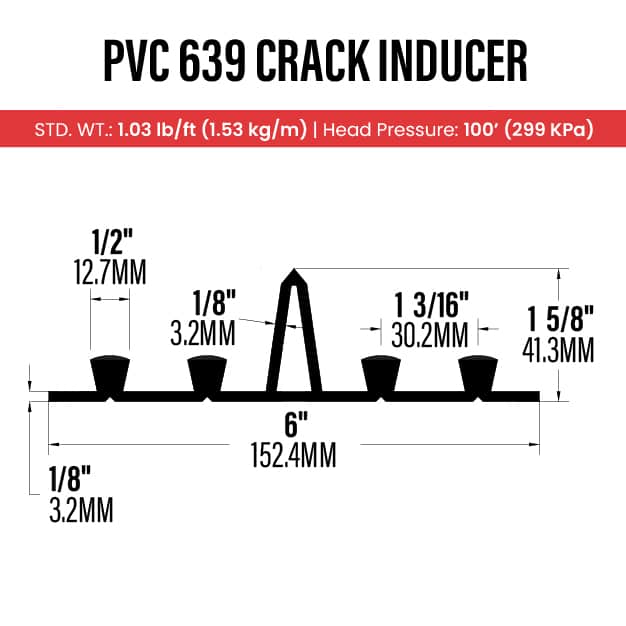
6″ · 1.03 lb/ft · 100 ft head (299 kPa)
Retrofit waterstop systems
Purpose-built for joints where new concrete is tied into an existing structure. Mechanically clamped to the existing concrete face with stainless steel batten bars and anchor bolts, sealed with structural epoxy.
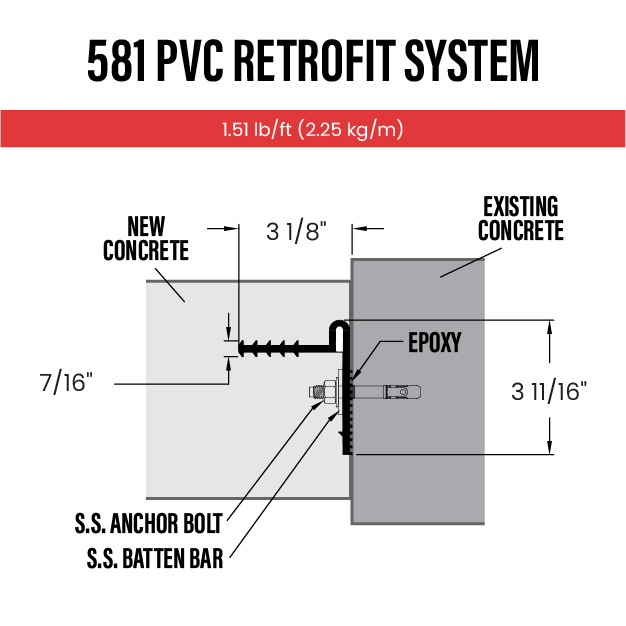
3 11/16″ · 1.51 lb/ft · meets ASTM & Corps of Engineers specs
NSF-61 certified
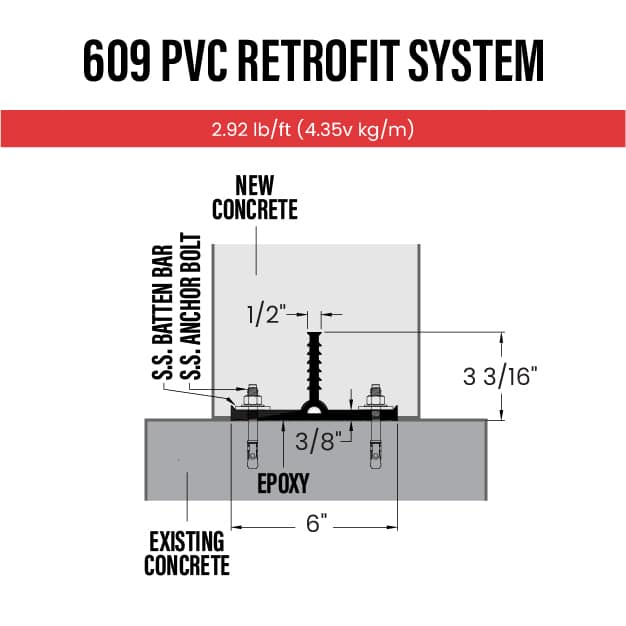
6″ · 2.92 lb/ft · meets ASTM & Corps of Engineers specs
NSF-61 certified
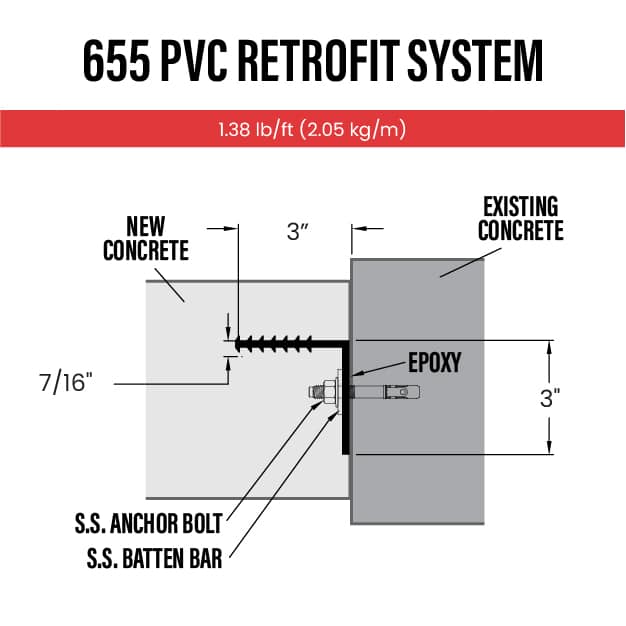
3″ · 1.38 lb/ft · meets ASTM & Corps of Engineers specs
NSF-61 certified
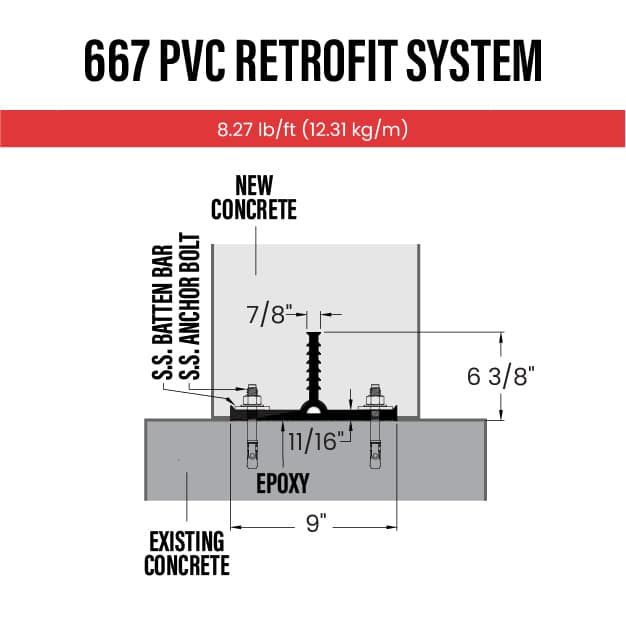
9″ · 8.27 lb/ft · meets ASTM & Corps of Engineers specs
NSF-61 certified
Factory fabrications: Waterstop failures occur most often at improperly field-welded transitions and intersections. Factory-made fabrications are strongly recommended for all profile changes, corners, and intersection points across every category in the lineup.
Physical properties — all PVC profiles
Every Sika Greenstreak PVC waterstop profile is extruded to a single proprietary PVC formulation that meets or exceeds the published physical property requirements of U.S. Army Corps of Engineers Specification CRD-C 572-74, along with applicable Bureau of Reclamation, CH2M HILL, MWH, and state DOT or public works standards. The values below apply across the entire product line.
A note on head pressure ratings: Hydrostatic head pressure ratings throughout this guide are derived from the methodology in U.S. Army Corps of Engineers document EM 1110-2-2101, Waterstops and Other Preformed Joint Materials for Civil Works Structures. These figures represent ultimate pressure capacity — not service-level design values. An appropriate safety factor should always be applied when matching a profile to a project’s design head pressure.
Installation overview
The quality of a PVC waterstop installation matters as much as the profile choice. The best-specified centerbulb waterstop will leak if it ends up misaligned, displaced, or twisted during the concrete pour. PVC waterstop must be firmly secured in the formwork ahead of placement and tied off to surrounding reinforcing steel so it can’t deflect or shift while concrete is poured and vibrated.
Position the waterstop in the joint. Center the profile on the joint line with half of the waterstop in the volume of the first pour and the other half projecting into the volume of the adjoining pour. Use split formwork or a waterstop chair appropriate for the profile geometry.
Secure against displacement. Anchor the profile using one of three standard methods: punched flanges on ribbed profiles for direct wire-tying, factory-installed brass grommets on selected profiles, or field-applied hog rings and pliers for any profile geometry.
Heat weld all splices and transitions. Use a thermostatically controlled splicing iron to butt-weld profile lengths. Solvent cement, adhesives, and mechanical splices will not produce a watertight bond. Factory-fabricated corners, tees, crosses, and transitions are strongly preferred over field-fabricated ones.
Place and consolidate the first concrete pour. Concrete must fully encapsulate the embedded portion of the waterstop, with no voids or honeycombing around the ribs or dumbbell flanges. Consolidate carefully but avoid contacting the waterstop directly with the vibrator head.
Strip formwork and place the adjoining pour. After the first pour cures, strip the bulkhead, inspect the projecting half of the waterstop for damage, and prepare the joint surface for the second pour. Place the adjoining concrete and consolidate around the remaining half of the profile.
Heat welding is the only recognized installation method for splicing PVC waterstop. Sika’s Waterstop Welding Certification Program is available for contractors and employees to fulfill training requirements. Full installation guides, splicing instructions, and retrofit application guides are available through Sika’s technical documentation library at usa.sika.com.
Compliance & certifications
Sika Greenstreak PVC waterstops are manufactured to meet or exceed the industry’s most demanding performance specifications. Every PVC profile in the Greenstreak line is NSF/ANSI 61 certified, making the entire line suitable for direct contact with potable water in drinking water treatment plants, reservoirs, and finished water storage.
Army Corps of Engineers CRD-C 572-74
ACI 350 — environmental engineering concrete
ASTM D638 — tensile & elongation
ASTM D624 — tear resistance
ASTM D746 — low temp. brittleness
ASTM D2240 — Shore A hardness
ASTM D570 — water absorption
ASTM D747 — stiffness in flexure
ASTM D792 — specific gravity
Sika Greenstreak PVC waterstops have also been independently tested against Bureau of Reclamation, CH2M HILL, MWH, and various state highway and public works department standards. Confirm current certification status and project-specific compliance requirements directly with Sika prior to final specification.
PVC waterstop design checklist
Use this checklist when specifying a PVC waterstop. Working through these items before finalizing the specification will reduce RFIs, minimize substitution requests, and ensure the installed system performs as intended for the life of the structure.
PVC waterstop companion products
PVC waterstop is often paired with complementary joint sealing products to handle conditions a traditional embedded waterstop can’t address on its own — penetrations, taper tie voids, hairline cracks, and joints that need a redundant secondary seal.
Modified chloroprene rubber strip with a delay coating that expands on contact with water to form a compression seal. Often installed alongside PVC waterstop as a redundant secondary line of defense.
Hydrophilic strip sealant compounded from bentonite clay and butyl rubber. Expands on contact with water to form a compression seal across non-working joints. Used with a compatible primer adhesive.
Re-injectable hose system installed in construction joints prior to concrete placement. After the structure is in service, the hose can be injected with resin or cementitious grout to seal cracks or voids.
Patented mechanical taper tie void plug engineered to permanently seal the cone-shaped void left in a concrete wall after a taper tie rod or pass-through tie sleeve is removed.
Frequently asked questions
Common questions from engineers, specifiers, and contractors about flexible PVC waterstops.
Ready to order or need help specifying?
Our team can help you select the right PVC waterstop profile and quantity for your project.