About Sika Greenstreak Dumbbell with Centerbulb PVC Waterstop
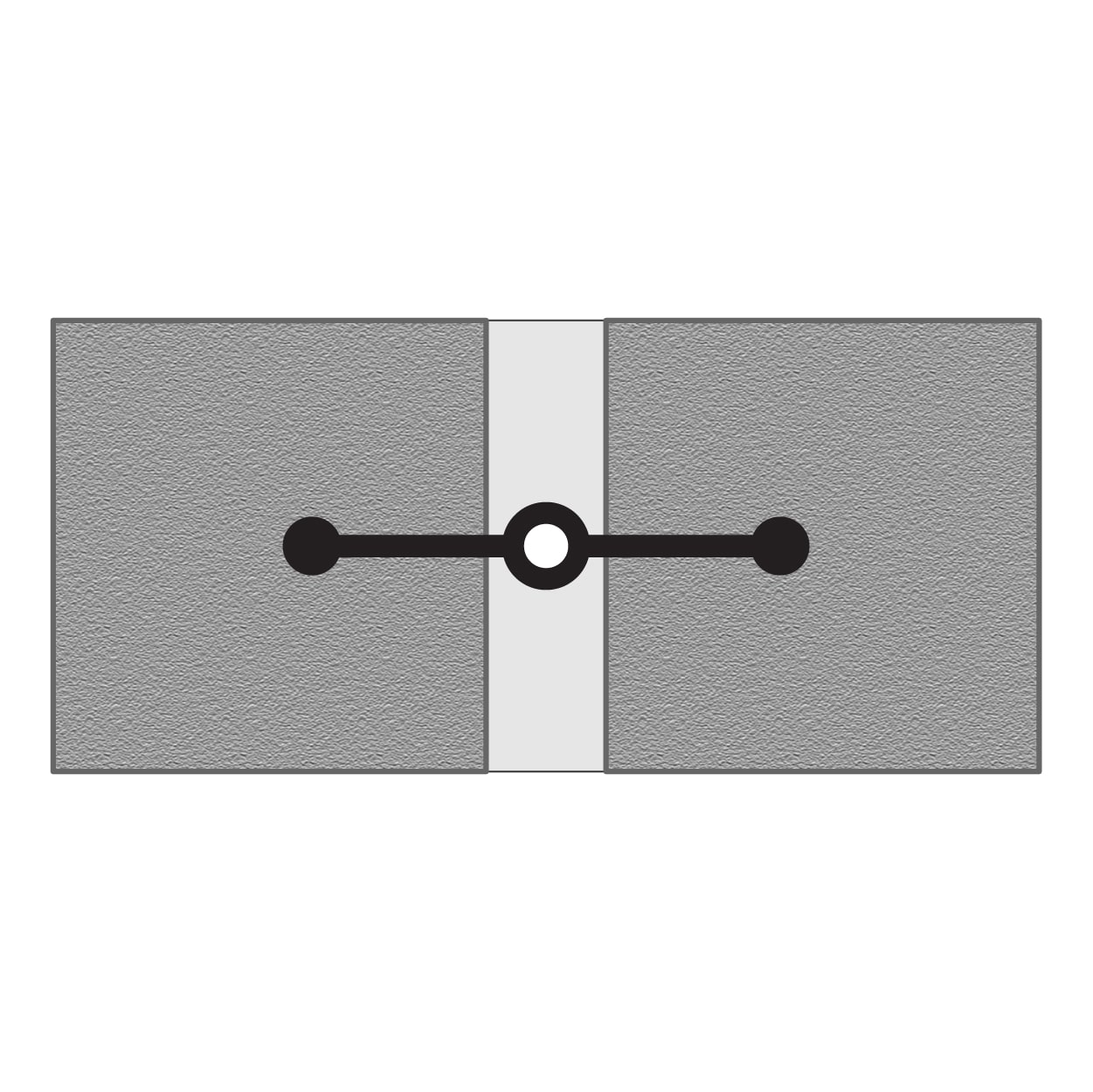
Sika Greenstreak dumbbell with centerbulb PVC waterstop is specified for movement joints in concrete construction. The hollow centerbulb sits over the joint and deforms to accommodate lateral, transverse, and shear movement — the three directions a joint may flex due to drying shrinkage, thermal expansion, settlement, and live load deflection. The smooth flanges terminate in enlarged dumbbell ends that anchor the profile into the concrete on both sides of the pour, forming a continuous diaphragm intended to prevent the passage of liquid through the joint.
Larger centerbulbs are generally associated with greater joint movement capacity. Dumbbell centerbulb profiles are produced in widths of 6 inches and 9 inches across a range of weights and head pressure ratings, with the appropriate size depending on the project’s expected joint movement, hydrostatic head pressure, and concrete thickness. See the sizing reference below or reach out for help selecting a profile for your specification.
Typical Applications
✓Commonly Specified For
- Expansion, contraction, and isolation joints
- Joints subject to lateral, transverse, or shear movement
- Water and wastewater treatment plants
- Reservoirs, aqueducts, and lock-and-dam systems
- Tunnels, culverts, and bridge abutments
- Containment structures and tanks
- Potable water contact applications
- Specifications calling for a dumbbell-style anchor
→Other Profiles May Be Considered When
- Better sealing characteristics are desired — see Ribbed Centerbulb
- The joint has continuous reinforcement and minimal movement — see Flat Ribbed or Dumbbell
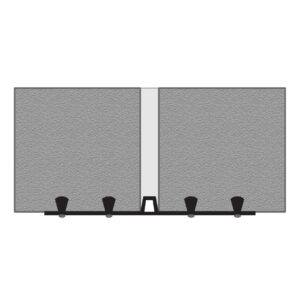
- The application is a slab-on-grade joint — see Base Seal
- The joint is at an existing concrete face — see Retrofit profiles
- Larger joint movements are expected — see Tear Web
Profile selection should always be verified against project specifications and engineering requirements. Contact us if you’d like assistance reviewing options for your application.
Available Sizes: Profiles 753, 754, and 757
Sika Greenstreak produces dumbbell centerbulb waterstop in a range of profile sizes to suit different joint widths, movement requirements, and head pressure ratings.
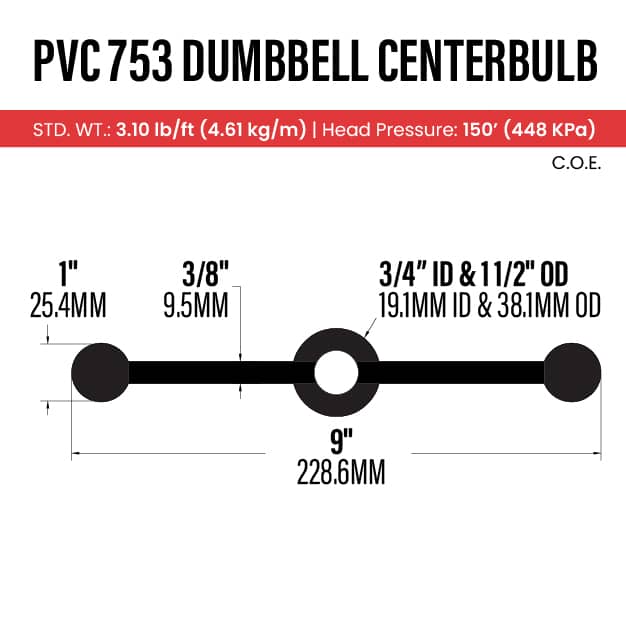
Profile 753
Width: 9″
Thickness: 3/8″
Weight: 3.10 lb/ft
Head Pressure: 150 ft (448 kPa)
Centerbulb: 3/4″ ID x 1 1/2″ OD
Profile 754
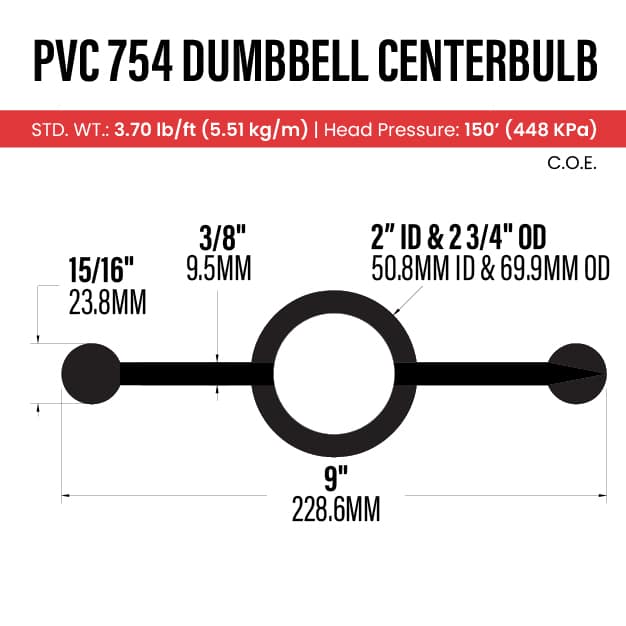
Width: 9″
Thickness: 3/8″
Weight: 3.70 lb/ft
Head Pressure: 150 ft (448 kPa)
Centerbulb: 2″ ID x 2 3/4″ OD
Profile 757
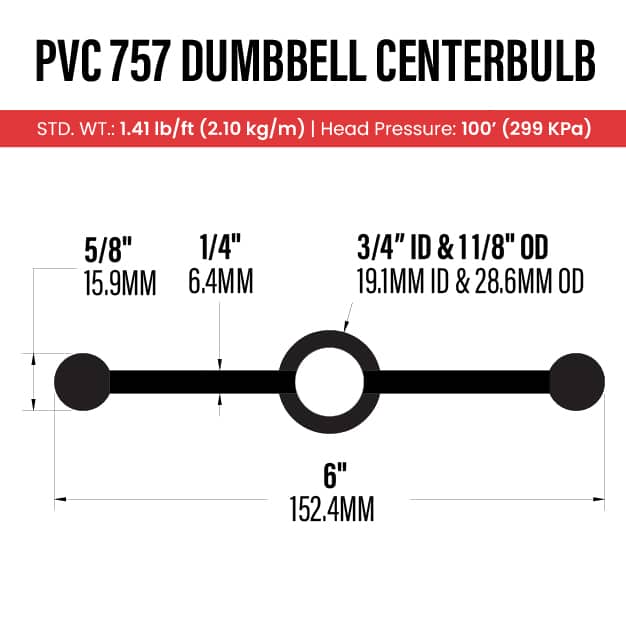
Width: 6″
Thickness: 1/4″
Weight: 1.41 lb/ft
Head Pressure: 100 ft (299 kPa)
Centerbulb: 3/4″ ID x 1 1/8″ OD
Sizing considerations generally include expected joint movement, hydrostatic head, and concrete cover. Contact us if you’d like help cross-referencing a profile against your spec.
Dumbbell Centerbulb Waterstop Installation Overview
Dumbbell centerbulb waterstops are typically installed prior to concrete placement using split formwork. Heat welding is generally the recognized method for splicing PVC waterstop, and factory-fabricated transitions are widely recommended to reduce the risk of failure at intersections. Always refer to the manufacturer’s installation guide and project specifications for complete instructions.
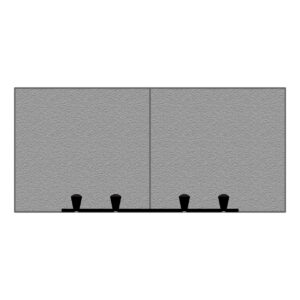
Center the waterstop over the joint with the centerbulb aligned and roughly half the profile projecting into each pour.
Tie off the outer flange to adjacent reinforcing steel using hog rings, punched flanges, or similar methods.
Heat-weld butt splices in the field. Factory fabrications are generally recommended for changes of direction.
Place and consolidate concrete around both flanges to encapsulate the waterstop fully.
Frequently Asked Questions
+How is a dumbbell with centerbulb different from a ribbed centerbulb?
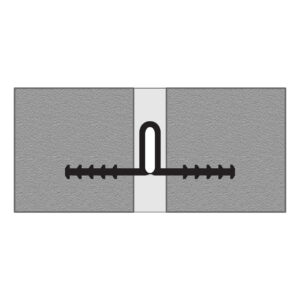
Both profiles are designed to accommodate the same three directions of joint movement (lateral, transverse, and shear). The difference is in how the flanges anchor into the concrete. Ribbed profiles use a series of ribs along the flange to create mechanical interlock and are generally noted for providing better sealing characteristics. Dumbbell profiles rely on enlarged bulb-shaped ends at the edges of the flanges to anchor the waterstop. Both are used in movement joints, and the right choice for any given project depends on the specification and engineering requirements.
+What’s the difference between Sika Greenstreak Profile 753, 754, and 757?
The 757 is the smallest of the three at 6″ wide, 1/4″ thick, and 1.41 lb/ft, rated for 100 ft of head pressure. The 753 steps up to 9″ wide and 3.10 lb/ft with a 3/4″ ID centerbulb, rated for 150 ft of head pressure. The 754 is the heaviest at 3.70 lb/ft and features a substantially larger 2″ ID centerbulb — intended for joints where greater movement capacity is required — also rated for 150 ft of head pressure. Project-specific requirements should always drive the final selection.
+Can dumbbell centerbulb waterstop be installed in a horizontal slab joint?
Yes, dumbbell centerbulb profiles can be installed in horizontal as well as vertical joints. For horizontal slab-to-slab joints, split formwork is generally used so that roughly half the profile is embedded in the first pour with the centerbulb aligned over the eventual joint, and the remaining flange projects up to be encapsulated in the second pour.
+Are factory-fabricated intersections necessary, or can they be done in the field?
Field-fabricated intersections are widely cited as a leading cause of waterstop performance issues. Sika recommends factory-made fabrications for L’s, T’s, crosses, and other changes of direction. Field welding is generally appropriate for straight butt splices between runs of waterstop. The project specification will typically indicate which approach is required.
+Is dumbbell centerbulb waterstop suitable for potable water structures?
All Sika Greenstreak PVC waterstop profiles, including each dumbbell centerbulb size, are NSF/ANSI 61 certified for potable water contact. This makes them appropriate for many applications such as finished water reservoirs and treatment plant clearwells, subject to project-specific requirements.
+How do you heat-weld dumbbell centerbulb PVC waterstop in the field?
PVC waterstop is typically heat-welded using a thermostatically controlled splicing iron. The two ends are squared, butted against the heated blade until the PVC begins to melt, then pressed together and held until cool. Sika offers a Waterstop Welding Certification Program for contractors seeking formal training, as weld quality has a significant impact on long-term performance.
+Is dumbbell centerbulb waterstop appropriate for expansion joints?
Yes — dumbbell with centerbulb is one of the standard PVC profiles specified for expansion joints, along with contraction and isolation joints. The centerbulb accommodates the lateral, transverse, and shear movement that expansion joints are designed to allow, and the dumbbell ends anchor the waterstop into the concrete on both sides. Profile selection for an expansion joint should account for expected movement magnitude, hydrostatic head, and the project specification — Profile 754 offers the largest centerbulb in this family at 2″ ID for greater movement capacity.